
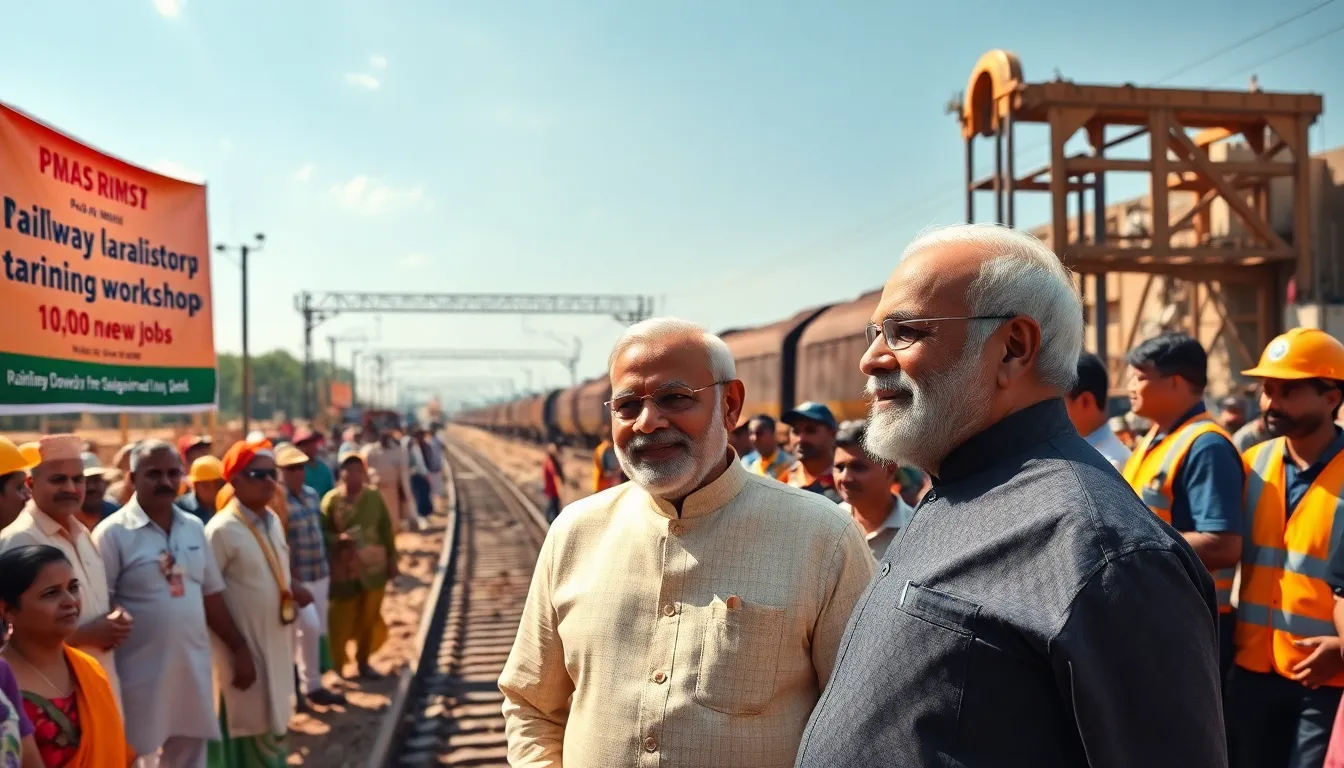
What development projects is Prime Minister Narendra Modi inaugurating in Dahod, Gujarat during his May 26-27, 2025 visit? The Prime Minister will officially launch multiple infrastructure and social welfare projects valued at over ₹24,000 crore aimed at transforming Dahod district’s economic and public services landscape.
Understand the Project Details
The centerpiece of the announced initiatives is a state-of-the-art railway component manufacturing workshop set up at a cost of ₹21,405 crore. This facility is designed to produce critical railway components, supporting Indian Railways’ modernization and capacity expansion plans. Located strategically in Dahod, the workshop aims to generate approximately 10,000 direct jobs, catalyzing local employment opportunities.
Rail infrastructure development includes doubling of key railway lines such as Anand-Godhra and Mehsana-Palanpur. Doubling increases track capacity, allowing more frequent and faster trains, thus boosting regional connectivity. Additionally, electrification of the Sabarmati-Botad rail line is underway, improving energy efficiency and reducing carbon emissions along this corridor.
Water infrastructure forms another critical component. Four major water supply schemes, collectively costing ₹181 crore, will provide clean drinking water to over 193 villages and Dahod city, impacting an estimated 462,000 residents in Dahod and the adjoining Mahi Sagar district. For example, a project in Balasinor taluka will connect 39 villages, benefiting over 101,000 people, while the Kheroli area scheme will serve 51 villages and 15,011 city residents in Virpur.
Urban development projects include construction of a new municipal building to improve administrative efficiency and an Adivasi Museum to preserve and promote the cultural heritage of Dahod’s tribal communities. Civic amenities will receive a ₹233 crore boost, targeting improvements in roads, public housing, and other infrastructure.
Identify Who Benefits and How
Local residents of Dahod district, including rural and urban populations, stand to gain from these projects. The railway workshop will provide employment opportunities across skill levels, from technical jobs to administrative roles. Farmers and villagers will benefit from improved water supply schemes, reducing waterborne diseases and enhancing agricultural productivity.
Commuters and businesses will experience improved connectivity and logistics due to railway line doubling and electrification, facilitating faster movement of goods and people. Municipal employees and local government officials will benefit from upgraded office facilities, while tourists and cultural enthusiasts gain from the new Adivasi Museum highlighting tribal art and history.
Explain Why the Government Launched These Projects
The Government of Gujarat, under the leadership of Prime Minister Modi, aims to accelerate balanced regional development by focusing on infrastructure upgrades and social welfare in Dahod. According to the Ministry of Railways and the Gujarat Water Supply and Sewerage Board (GWSSB), these investments address historical underdevelopment in tribal and rural areas.
The railway projects support the national initiative to enhance rail capacity and sustainability, aligning with the Indian Railways Vision 2030. Water projects target the United Nations Sustainable Development Goal of clean water and sanitation, directly improving public health outcomes in Dahod and Mahi Sagar districts.
Urban development projects aim to strengthen local governance and preserve cultural identity, promoting tourism and civic pride. Overall, these projects are intended to boost economic growth, reduce regional disparities, and improve quality of life for approximately half a million residents.
Summarize Criticisms and Stakeholders’ Views
While most local leaders and residents have welcomed the projects, some environmental groups express concerns about the ecological impact of large-scale manufacturing and railway expansion. The Gujarat State Pollution Control Board has been tasked with monitoring compliance to environmental regulations.
Some critics argue that job creation estimates may be optimistic and call for transparent implementation and skills training programs to ensure local populations benefit. The Tribal Welfare Department of Gujarat has emphasized the importance of involving tribal communities in planning and execution to preserve their rights and culture.
Conversely, the Gujarat Chamber of Commerce and Industry lauds the initiatives for potential to attract further investment and improve regional industrial competitiveness.
Highlight What Residents Should Do Next
Residents and stakeholders in Dahod and Mahi Sagar districts can prepare to engage with these developments as follows:
- Stay informed about project timelines and public consultations via official Gujarat government portals and local district offices.
- Seek information from the Dahod District Collectorate about employment opportunities at the new railway workshop and associated industries.
- Participate in community meetings regarding water supply schemes to ensure smooth implementation and maintenance.
- Visit the upcoming Adivasi Museum to support and learn about local tribal heritage.
The Government of Gujarat has also set up a special control room in Dahod during the Prime Minister’s visit to coordinate citizen safety and address queries, as reported by official sources.
For further details on these initiatives, readers can refer to the official announcements linked here: Prime Minister Modi to Launch Development Projects Worth ₹24,000 Crores in Dahod and Prime Minister Modi’s Two-Day Visit to Gujarat: Key Development Projects Unveiled.