
Location: Dharnidhar taluka, Banaskantha district, Gujarat
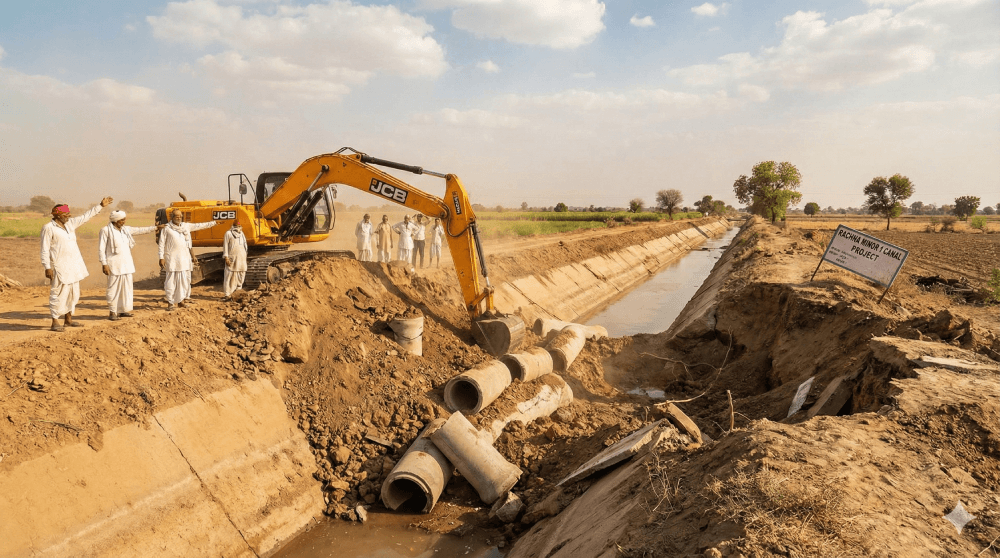
A newly repaired stretch of the Rachna Minor-1 canal in Dharnidhar taluka has reportedly collapsed just two days after completion, sending shockwaves through the local farming community. As water was released into the canal, a long portion of the repaired section is said to have broken, allowing water to gush into nearby fields and damage standing crops.
Farmers who were expecting a reliable irrigation source now say the failed repair has brought them financial loss, stress and uncertainty. The incident has raised serious questions about construction quality, supervision and accountability in public works projects.
New Canal Repair Fails Within 48 Hours
According to local reports, around 700 metres of the Rachna Minor-1 canal were recently repaired. The work was meant to improve water flow and support farmers during an important phase of the agricultural season. However, barely 48 hours after completion, trouble started as soon as water was released into the canal.
Instead of moving smoothly through the repaired stretch, water allegedly began to leak and then break through the structure. Within a short time, a significant part of the repaired canal wall gave way. For villagers watching from the banks, the scene was both shocking and worrying, as they realised that a project meant to protect their livelihoods had failed almost immediately.
Water Floods Fields and Damages Standing Crops
The canal breach allowed water to flow directly into surrounding agricultural land. Farmers report that:
- Water entered fields in an uncontrolled and forceful way.
- Standing crops were submerged and damaged.
- Soil, bunds and field boundaries were washed away in some areas.
This incident came at a time when crops required controlled irrigation, not flooding. Many farmers had already invested heavily in seeds, fertiliser and labour. They now fear that their expected returns will fall sharply because of the sudden waterlogging and crop damage caused by the failed repair.
For small and marginal farmers, even one damaged season can be difficult to recover from. That is why the reported collapse of the Rachna Minor-1 canal repair has become a major concern for the entire village and surrounding areas.
Written Complaint Highlights Irregularities in Canal Repair
In response to the incident, the Sarpanch of Rachna village, Kiran Singh Rajput, has submitted a detailed written complaint to the Chief Engineer. The representation describes what are claimed to be serious irregularities in the repair of the canal.
The complaint states that:
- The material used in the repair was of very low quality.
- Concrete curing time – the period needed for concrete to gain strength – was not respected.
- The mix of concrete may not have followed recommended technical standards.
- There was a lack of proper on-site supervision during the work.
- Final inspection before releasing water into the canal was weak or ineffective.
These points suggest that the repair may have focused more on completing the work quickly than on ensuring that it would last. In normal conditions, a properly executed canal repair should serve farmers for many years. A failure in just two days strongly indicates deeper problems in planning, execution or oversight.
Questions Over Inspection and Responsibility
One of the most serious issues raised by villagers is the role of inspection. For large public works, engineers and officers are expected to:
- Visit the site during construction.
- Check the quality of materials and workmanship.
- Certify the work only after it meets required standards.
In the case of Rachna Minor-1, villagers are asking whether inspections were done in a meaningful way or only completed on paper. They want to know:
- Who checked the work before it was approved?
- Were any warnings or defects reported?
- Why was water allowed into the canal if parts of the structure were still weak?
These questions are not only about one project. They also touch on a larger concern: whether the system for checking public works is strong enough to protect public money and people’s livelihoods.
Farmers Demand Inquiry, Blacklisting and Fresh Quality Repair
The Sarpanch and affected farmers are calling for strong, time-bound action. Their main demands include:
- Setting up a high-level inquiry committee to investigate the canal repair work, including all technical and financial aspects.
- Conducting laboratory testing of the construction materials used, so that an independent assessment of quality can be made.
- Blacklisting the contractor or agency responsible, if the inquiry confirms that poor-quality work or negligence took place.
- Carrying out fresh repair work on the damaged stretch, this time strictly following quality standards and at the contractor’s cost, not from public funds.
- Taking disciplinary action against any officials who failed to supervise the work properly or allowed weak construction to be passed.
Farmers stress that such steps are necessary not only to fix the present problem but also to prevent similar failures in future projects. They want to see clear signals that negligence in public works will lead to real consequences.
Bigger Questions About Public Infrastructure Quality
While the Rachna Minor-1 canal incident may involve a single project, it points towards a larger issue – the quality and transparency of rural infrastructure work. Canals, roads, tanks and other basic facilities are crucial for village life. When these structures fail, the people who suffer first are usually those with the least financial security.
If a canal repair can collapse within days, villagers naturally begin to wonder:
- Are other canals and irrigation structures also at risk?
- Is public money being used effectively?
- Are checks and balances strong enough to stop poor-quality work?
The answers to these questions will shape how much trust people place in future projects. Confidence in public infrastructure is built slowly, but it can be damaged very quickly when a key structure fails in such a visible way.
Trust, Accountability and the Road Ahead
For the farmers affected by the Rachna Minor-1 canal collapse, this is not just a technical story about concrete and construction. It is about trust. They trusted that the repair would protect their fields and help their crops, especially during a critical period of the season. Instead, they now face losses and uncertainty.
Rachna Minor-1 canal in Dharnidhar taluka reportedly collapsed just two days after repair, flooding farmers’ fields and raising questions about poor construction quality, weak inspection and accountability.The next steps taken by the authorities will play a major role in rebuilding that trust. A transparent inquiry, fair responsibility and visible corrective action can send a strong message that accountability matters. On the other hand, if the issue is delayed or ignored, it may deepen frustration and doubt among villagers.
For now, farmers and local residents are watching closely to see how quickly and seriously their concerns are addressed. The future of the Rachna Minor-1 canal – and the confidence of those who depend on it – will depend on whether strong action follows strong words.