
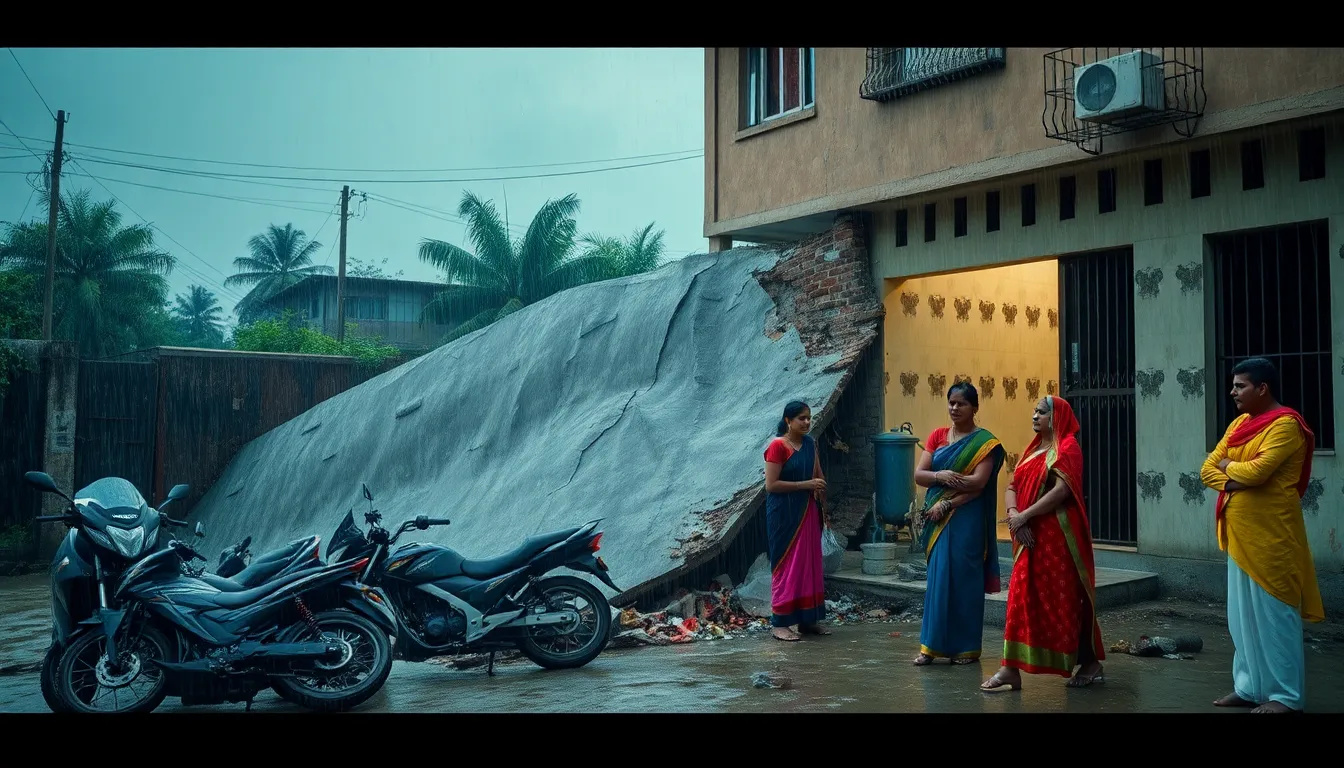
Over 100 meters of protective infrastructure failed last night in Palanpur, the Banaskantha district headquarters, as a protection wall near Dhundhiyawadi collapsed under the strain of intense rainfall, lightning, and strong winds. This incident, while causing no casualties, has raised urgent concerns about the durability and upkeep of critical urban defenses in the face of Gujarat’s increasingly volatile monsoon patterns.
5 Key Details About the Palanpur Wall Collapse
At approximately 10:30 PM on June 22, 2024, continuous heavy rain combined with gusty winds caused a protective boundary wall adjacent to residential houses near Palanpur Railway Station to give way. According to the Banaskantha District Disaster Management Authority (BDDMA), the wall measured roughly 120 meters in length and was constructed to shield homes from flooding and soil erosion during monsoons.
When the wall collapsed, it fell on several parked two-wheelers, a large overhead water tank, and partially blocked the entrance to a nearby dwelling. Luckily, no residents were in the immediate vicinity, averting potential injuries or fatalities. The local railway department quickly dispatched repair teams to clear debris and began structural reinforcement works by early morning June 23.
Residents of Dhundhiyawadi and adjoining localities expressed alarm over the incident. Many highlighted that maintenance of such walls had been irregular, with no recent inspections or repairs noted. The collapse has prompted calls for a comprehensive safety audit of similar structures across Palanpur’s vulnerable neighborhoods.
Following the event, the Banaskantha Collector’s office directed the Municipal Corporation and Public Works Department (PWD) to conduct immediate assessments and prioritize repairs. A formal inspection schedule for all stormwater protection walls in Palanpur is expected to be published within the next two weeks.
3 Historical and Cultural Insights Into Palanpur’s Urban Landscape
Palanpur, established in the early 14th century by the Paramara Rajput ruler Pal Parmar, has always balanced historical heritage with urban growth. As the administrative center of Banaskantha district, it acts as a key commercial and transport hub, connected by National Highway 27 and the Western Railway network.
The city’s older neighborhoods, including Dhundhiyawadi, were originally developed without modern drainage or flood protections, relying instead on traditional embankments and walls. Over the decades, rapid urbanization has outpaced infrastructure upgrades, leaving certain protective barriers vulnerable during extreme weather.
Notably, Palanpur has experienced an uptick in monsoon rainfall intensity since 2018, as recorded by the Gujarat State Disaster Management Authority (GSDMA). This has put further pressure on aging infrastructure, underscoring the need for modernization and climate-resilient urban planning.
4 Current Status: Repairs and Weather Conditions
As of June 24, repair teams from the Palanpur Railway Division and Banaskantha Municipal Corporation have restored partial structural integrity to the collapsed wall section. The water tank affected by the fall has been inspected and declared safe for continued use.
Train services passing through Palanpur Railway Station experienced delays and rerouting over the past two days. The Western Railway’s Palanpur Division issued advisories urging passengers to check the latest updates before travel. Additionally, the Met Department forecasts continued moderate to heavy rain over Banaskantha through June 26, urging vigilance.
Local authorities are also monitoring water levels at Gobri Lake, which recently overflowed due to heavy rains, threatening low-lying areas. Traffic congestion on major roads, including National Highway 27 near Palanpur, has been reported, with ongoing efforts to manage flow.
6 Community Impact and Official Responses
Residents in Dhundhiyawadi and surrounding neighborhoods have expressed concerns about property damage and potential future risks. Some reported water seepage into homes due to the compromised wall, while others feared disruption to daily life if repairs take longer than expected.
Banaskantha District Collector Mr. Dinesh Patel addressed the community on June 23, assuring that safety inspections and infrastructure reinforcement would be accelerated. He emphasized the need for community cooperation in reporting damage and adhering to safety advisories, especially during ongoing rains.
Experts from Gujarat University’s Department of Civil Engineering have offered to assist local authorities in conducting structural assessments and recommending resilient construction techniques tailored to Palanpur’s climate and soil conditions.
4 Steps Residents Should Take Now
- Stay informed via official channels such as Banaskantha Municipal Corporation and Western Railway updates.
- Report any visible cracks, waterlogging, or signs of wall instability immediately to the nearest ward office.
- Ensure evacuation routes remain clear and avoid parking vehicles near vulnerable structures.
- Participate in community meetings or awareness programs organized by local authorities.
This incident is a stark reminder of the challenges Palanpur faces as it adapts to changing weather patterns amid urban growth. With proactive maintenance and community engagement, future collapses can hopefully be prevented.
For more details, readers can follow ongoing updates on the Palanpur rain situation and related infrastructure news on news.gujarat.in.
Bottom Line: The collapse of the protection wall in Palanpur underscores urgent infrastructure vulnerabilities amidst heavy monsoon rains; residents and authorities must collaborate closely to ensure safety and timely repairs.